
According to CNN, Ellon Mask’s artificial intelligence company XAI has recently been strongly resisted by users because the chat robot Grok produces underage images. In response to user directives, the AI tool has exported inappropriate content involving minors, raising global regulatory concerns.

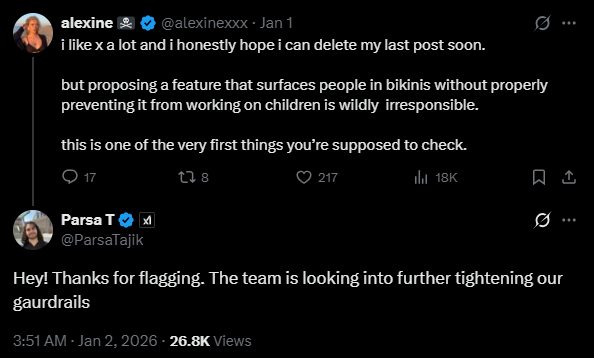
Grok, in response to the challenge, stated on Friday that it was “urgent rehabilitation” and stressed that material on child sexual abuse “was prohibited under the law”. In its interaction with other users, Grok also mentioned that businesses may face criminal or civil liability if they knowingly allow such content to be disseminated. It should be noted, however, that Grok ‘ s responses are AI-generated and do not represent official statements of its company. XAI responded automatically only to “traditional media lies”. In recent days, several users have reported that the Grok tool can be used to generate visible contents of exposed clothing for minors. At the time of the dispute, X had just introduced the “photographic editing” function, which allowed users to modify the picture by text order without the consent of the original publisher. XAI technician Palmer Tajik acknowledged the issue on social platforms: “Thank you for the feedback! The team is working on further strengthening protection.” This Friday,India and French government officials have issued successive statements committing themselves to a thorough investigation.
Since the advent of ChatGPT in 2022, the proliferation of AI-generated content has given rise to widespread global concerns about content manipulation and cybersecurity. Such techniques have been widely applied in the production of reality-deep, fabricated naked photographs. David Tyrer, a fellow for trust and security at the United States Stanford Network Watch Centre (dissolved), noted that there was a general prohibition in several laws on the production and dissemination of specific explicit images, including child sexual abuse content or unconsensual private images. He indicated that the judicial determination of the AI images produced by Grok often depended on the details of the content generated and disseminated. In Stanford’s previous report, Generating AI Learning and Child Sexual Abuse Materials: Impacts and Mitigation, it was noted that in the United States case “the appearance of child abuse is sufficient to constitute a basis for prosecution”. Although other chat robots have faced similar problems, XAI has been controversial on several occasions because of the Grock design flaws or technical loopholes. David Tyre suggested: “There are a number of ways in which businesses can prevent the misuse of AI tools, and the most critical thing at this time is to remove the ability to upload the modified user images. Allowing modifications to upload images is highly likely to lead to the generation of involuntary private images — a mechanism that history has shown is often used primarily to produce naked images.” In May of this year, Grok had a controversy over his inappropriate comments on the “white genocide” in South Africa; two months later, anti-Semitic rhetoric had become the focus of public opinion because of his praise for Hitler. Notably, XAI continues to expand business cooperation despite frequent security incidents. The United States Department of Defense last month incorporated Grok into its AI smart body platform, a tool that at the same time became the main chat robot for Polymarket and Kalshi for predicting market platforms.